

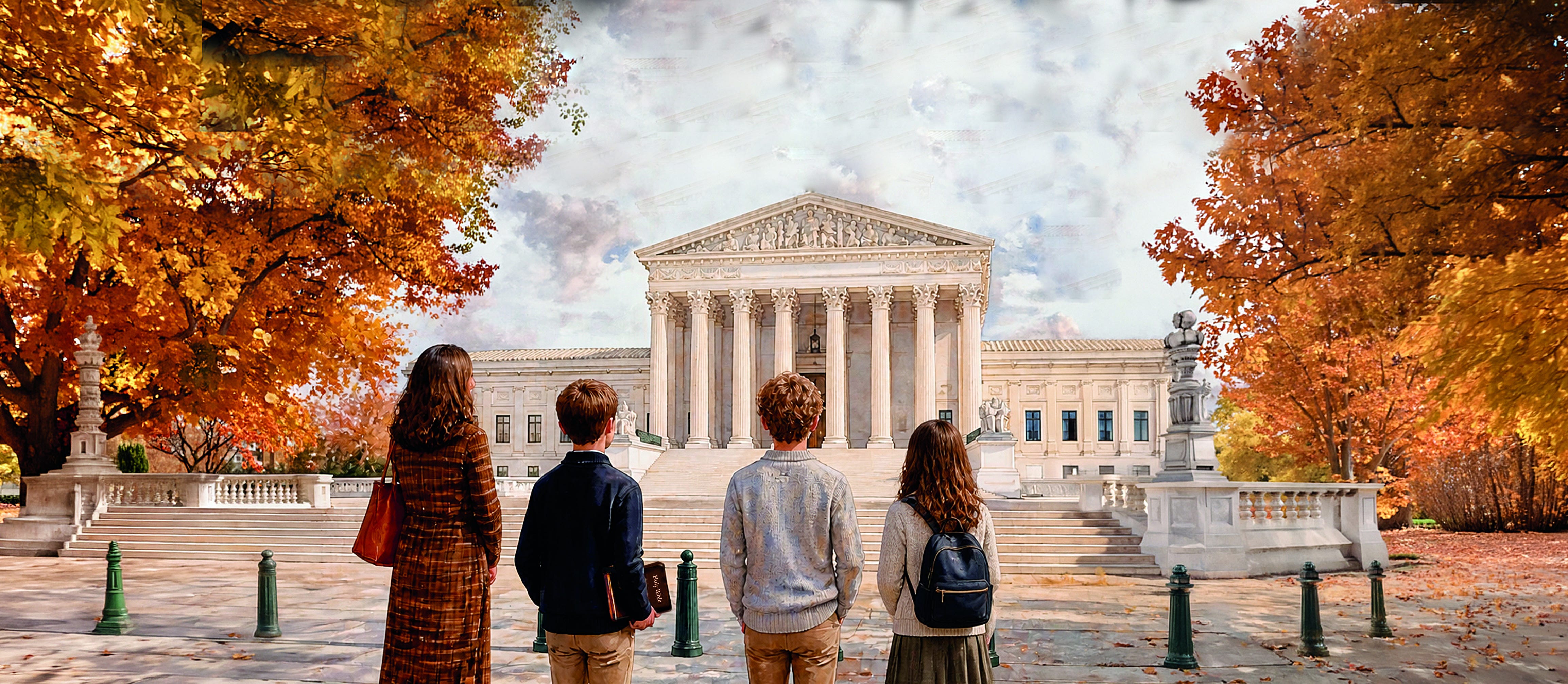
As school starts this fall, both students and teachers need to understand that, as the U.S. Supreme Court has ruled, they do not “shed their constitutional rights to freedom of speech or expression at the schoolhouse gate.” In fact, the U.S. Constitution fully protects their free speech and religious expression rights.
However, there are times when school officials, parents, and students alike are uninformed or confused about these rights, which far too often leads to bias, censorship, and viewpoint discrimination in schools.
Teacher Disciplined for Opening Classroom to Christian Students
Recently, for example, a Greater Hartford-area school district in Connecticut announced it would discipline a middle school teacher for allowing Christian students to use her classroom during lunch to pray, read the Bible, and discuss religion.
The district imposed a two-day unpaid suspension on this Christian teacher and added a letter of reprimand to the instructor’s file. The district also informed Christian students that they were prohibited from meeting to engage in lunchtime religious activity.
The penalty was imposed even though this teacher and others had accommodated Muslim students in their religious expression and practice during lunchtime without discipline. Despite that, district administrators characterized this teacher’s allowing Christian student religious exercise during non-instructional time as a “lack of professional judgment.” In a disciplinary meeting with the teacher, the principal even said he had also met with the students to ensure “they understand what they can and cannot do.”
School District Falls in Line with the First Amendment
Liberty Counsel responded with a demand letter on May 12, informing the school district that students have the First Amendment right to engage in voluntary religious activity on campus during non-instructional time — this teacher did not participate in the religious activity but only allowed the small group of students to use her classroom, issued hall passes for lunchtime transit, and otherwise facilitated student religious exercise with parental permission.
We noted that punishing a teacher for accommodating Christian religious exercise under substantially similar terms by which the district has accommodated other religions violates the First Amendment Free Speech and Free Exercise Clauses, the Equal Access Act, and the Connecticut Religious Freedom Exercise Act.
In response to the letter, the school district acknowledged that legal precedents “make clear” that students “have the right to engage in prayer and discussion” during free time, and teachers are permitted to accommodate those activities in a non-participatory status. The district removed the discipline from the teacher’s record and will permit lunchtime prayer, Bible study, and discussion for Christian students as classes resume this fall.
This teacher, who is a member of Christian Educators, will have no discipline for accommodating the religious needs of her students, and the students are able to resume their lunchtime Bible study — and the Constitution protects their right to do so.

Christian Teachers Cannot Be Forced to Lie
Not only do religious liberty protections allow teachers to open their classrooms to a student-facilitated Bible study, but a school cannot force teachers to affirm ideologies that directly contradict their convictions. In Los Angeles Unified School District (LAUSD), Christian teachers faced this scenario: Affirm falsehood or risk losing your job. After completing mandatory LGBTQ+ cultural training, teachers were forced to answer “yes” to the following prompt: “I am aware that LAUSD policy requires me to affirm and respect the identities of all students, including those who identify as LGBTQ+.”
Their failure to affirm this statement to complete this certification training could have jeopardized their livelihood. On behalf of Christian educators who could not contradict their biblical beliefs and affirm such a statement, Liberty Counsel sent a demand letter on June 8.
Two days after receiving the letter, LAUSD changed the language and removed the requirement to “affirm” all gender identities. The updated language signifies that LAUSD educators only need to acknowledge what the district’s policy is, rather than accept and agree with it.
Federal law protects teachers from being forced to “affirm” a student’s perceived “gender identity” or use false pronouns in violation of their religious convictions, and teachers should not give in to unconstitutional pressure to affirm what they know to be false.
Religious Liberty Supported by Decades of Legal Precedent
Christian teachers and students should also be encouraged and emboldened by decades-worth of legal precedent, affirming the First Amendment within the schoolhouse gate, including that:
Students have the right to express themselves, as long as it doesn’t disrupt the educational environment. (Tinker v. Des Moines Independent Community School District, 1969)
Students can express their religious beliefs in the classroom when they are relevant to the assignment or classroom discussion. However, schools are permitted to regulate speech in school-sponsored activities (e.g., school newspapers, assemblies) to ensure it aligns with educational goals but cannot prohibit expression without a legitimate educational purpose. (Hazelwood School District v. Kuhlmeier, 1988)
Public schools must remain neutral regarding religion. (Everson v. Board of Education, 1947)
A school may not prohibit student religious speech solely because it might be offensive to some. (Morse v. Frederick, 2007)
Schools can prohibit obscenities, hate speech, and threatening speech. (Tinker v. Des Moines Independent Community School District, 1969; Bethel School District v. Fraser, 1986; and Virginia v. Black, 2003).
On top of this, Liberty Counsel is undefeated in defending Child Evangelism Fellowship’s Good News Clubs and the right of these after-school Bible clubs to spread the Gospel and minister to students on public school campuses.
Under the First Amendment, public schools cannot prevent students from religious practice during their free time, nor can they discriminate against Christian viewpoints regarding use of school facilities or force students and teachers to violate their faith.
The freedom of religion does not disappear past the schoolhouse gate, and Christian students and teachers should not be intimidated out of abiding by their faith in a public school setting.
Click HERE for more from Mat Staver, Founder and Chairman of Liberty Counsel and Chairman of Liberty Counsel Action.